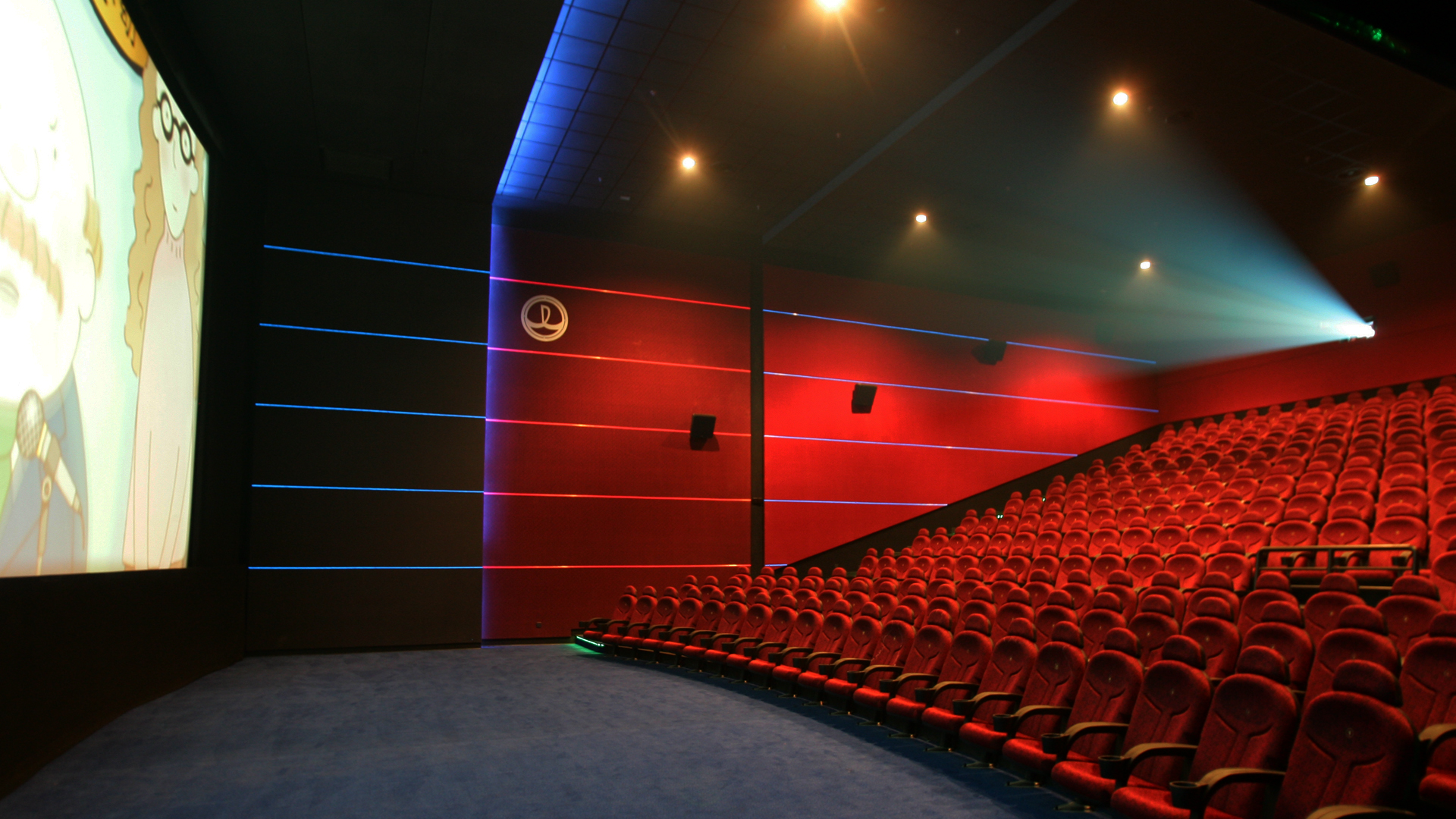
Spectral™ 240 is a special ultra-high brightness screen gives excellent performance with “passive” 3D applications using polarised light such as RealD. It also performs well under 2D conditions. Silver aluminium flake based coating applied to the unique base material provides high gain characteristics, strong signal to noise ratios, generous viewing angles and excellent colour temperature.
Our proprietary and unique seam welding process ensures our screens have no visible seams under projection conditions. Screens are available in either perforated or non perforated forms depending on speaker placement. Spectral 240 cannot be folded and must be rolled for transportation.
Screens are perforated to facilitate the acoustic performance of behind-screen speakers. For most cinema auditoria, standard perf pattern is used. For close viewing (less than 5m/16ft), mini-perf pattern is recommended.
Non-perforated screens are available for use when there are no speakers situated behind the screen.
| Spectral™ 240 | |
| Material | PVC with aluminium coating |
| Colour | Silver |
| Perforation | standard or mini-perf |
| Weight | 0.50 kg/m2 (0.10 lb/ft2) |
| Thickness | 0.3mm |
| Maximum size | USA plant: 23.77 x 12.19m (78' x 40') Europe: 33 x 11m (108' 3" x 36' 1") |
| Packing method | rolled |
| Fire classification | UK USA NFPA 701 Japan Korea France M2 Germany B1 Australia |
Screens should normally be transported and stored at temperatures between 5°C and 30°C (40°F and 85°F), with relative humidity less than 80%.
If screens are very cold (e.g. following air transport) then they must be allowed to warm up before unpacking, otherwise cold cracking may occur. Screens should be installed within a maximum of 2 months of shipping. Packages should be handled with care to avoid damage.
The general environment where the screen is installed should be kept reasonably clean to avoid dirt and dust build-up. Screens can be periodically cleaned using a soft brush or cloth, doing this vertically with limited pressure. Screens can be cleaned using a damp cloth wetted with water and a mild detergent. Under no circumstances should screens be cleaned with abrasive materials or harsh chemicals such as acids, bleaches or solvents. Harkness Screens is not liable for damage caused to screens through the use of inappropriate cleaning methods or chemicals.
For information on Installation, please see the Resources section of our website.